Appearance
Storytelling
We are surrounded by stories. These stories affect our attitudes, beliefs, and form our entire perception of reality. Historically, stories are how humans have transferred knowledge from generation to generation. Everything a designer does will be in support of telling stories and by extension, shape the world we inhabit.
Storytelling has a long history as a mechanism of knowledge transfer and can be considered a rapid immersion in an experience: One cannot experience time travel, but one can gain knowledge about the act of time travel through a rich compelling, and highly experiential story.
– Jon Kolko
Lesson Objective
The goal of this lesson is not to teach you every facet and application of storytelling. Mastering this subject, as with most subjects, will take quite a long time. Instead, you will learn about common elements of storytelling, structural models, and methods for building stories that you can apply as a framework for most of what you create and communicate as a designer.
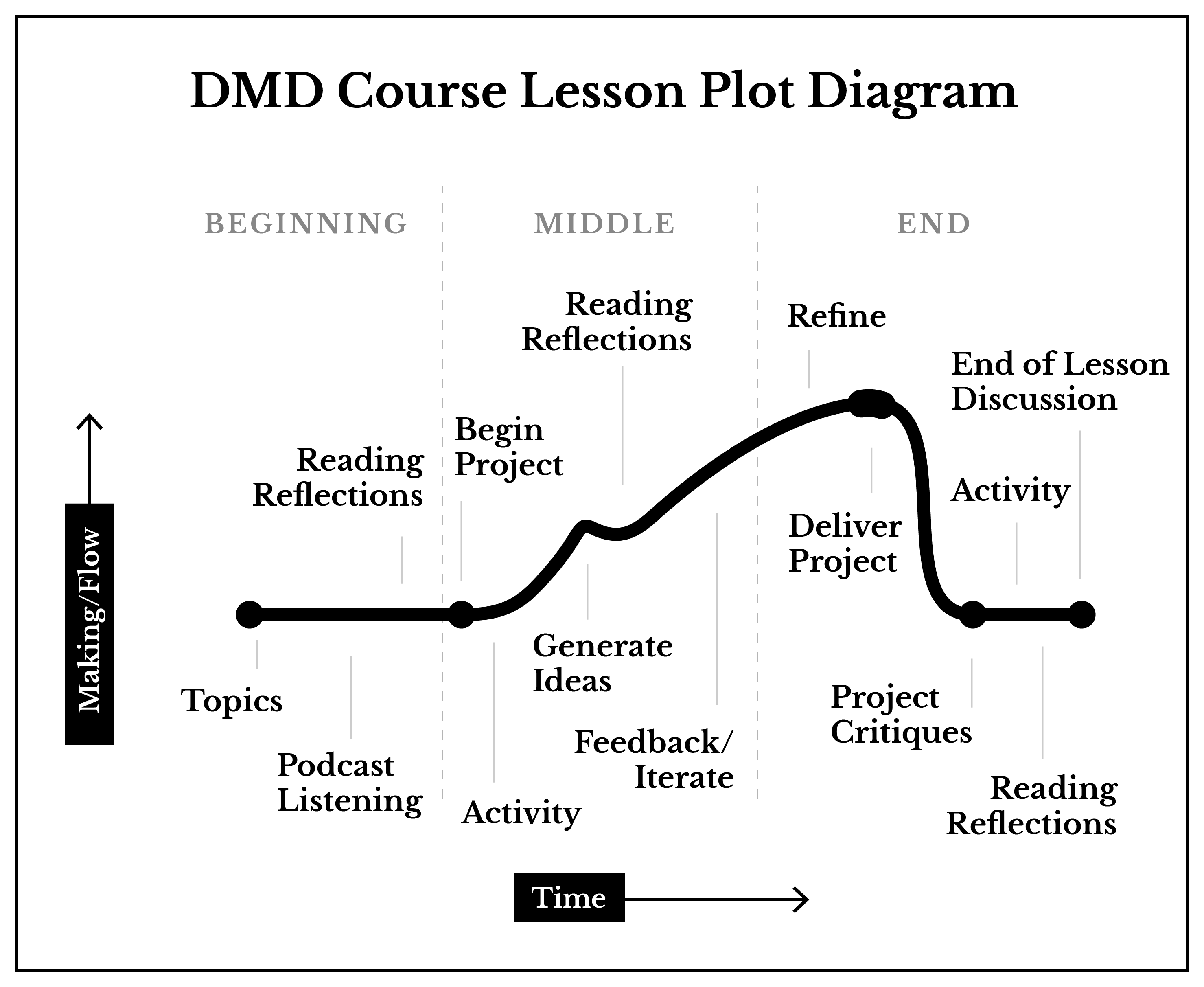
In this lesson, you will complete the following:
- Read, watch, and listen to lesson topics and media
- Reading assignment short reflections
- Two activities
- Interactive story project
- End-of-lesson course-wide discussion
Citation
- Kolko, Jon. Thoughts on Interaction Design: a collection of reflections / written and compiled by Jon Kolko. Second Edition. (2011) P.43 ISBN: 978-0-12-380930-8
